What Becomes Scarce After Intelligence?
Nuclear reactors and downloadable models look like opposite strategies. They’re two sides of one wager on a question nobody will say out loud: does intelligence have a ceiling?
Two things happened this year that look like they belong to different industries.
In the first, the most valuable companies on earth became nuclear utilities. Microsoft restarted Three Mile Island. Amazon locked in nuclear power through 2042. All told, hyperscalers committed around 9.8 gigawatts of nuclear to AI in about a year, and sovereign wealth funds poured roughly $120 billion into the buildout. The bet underneath all of it: whoever delivers the most power wins. Build the biggest machine. Out-electrify everyone.
In the second, over two weeks this July, the floor fell out of the model business. Five frontier-adjacent open models shipped in a single window — Moonshot’s Kimi K3 at 2.8 trillion parameters, an American entry under a fully open license, DeepSeek’s V4, GLM-5.2, MiniMax’s M3. Kimi K3 hit number one on a coding leaderboard within hours, past a closed frontier model, at a fifth of the price, with weights you can download and run yourself. The gap between the best open model and the best closed one is now measured in months, not years. The bet underneath this one: intelligence is about to be free, and the value drains out of the model and onto whatever hardware you happen to own.
These look like opposite strategies. One spends hundreds of billions making intelligence bigger. The other gives it away. They are not opposite. They are two sides of a single wager, and almost nobody placing it will name the question they’re betting on.
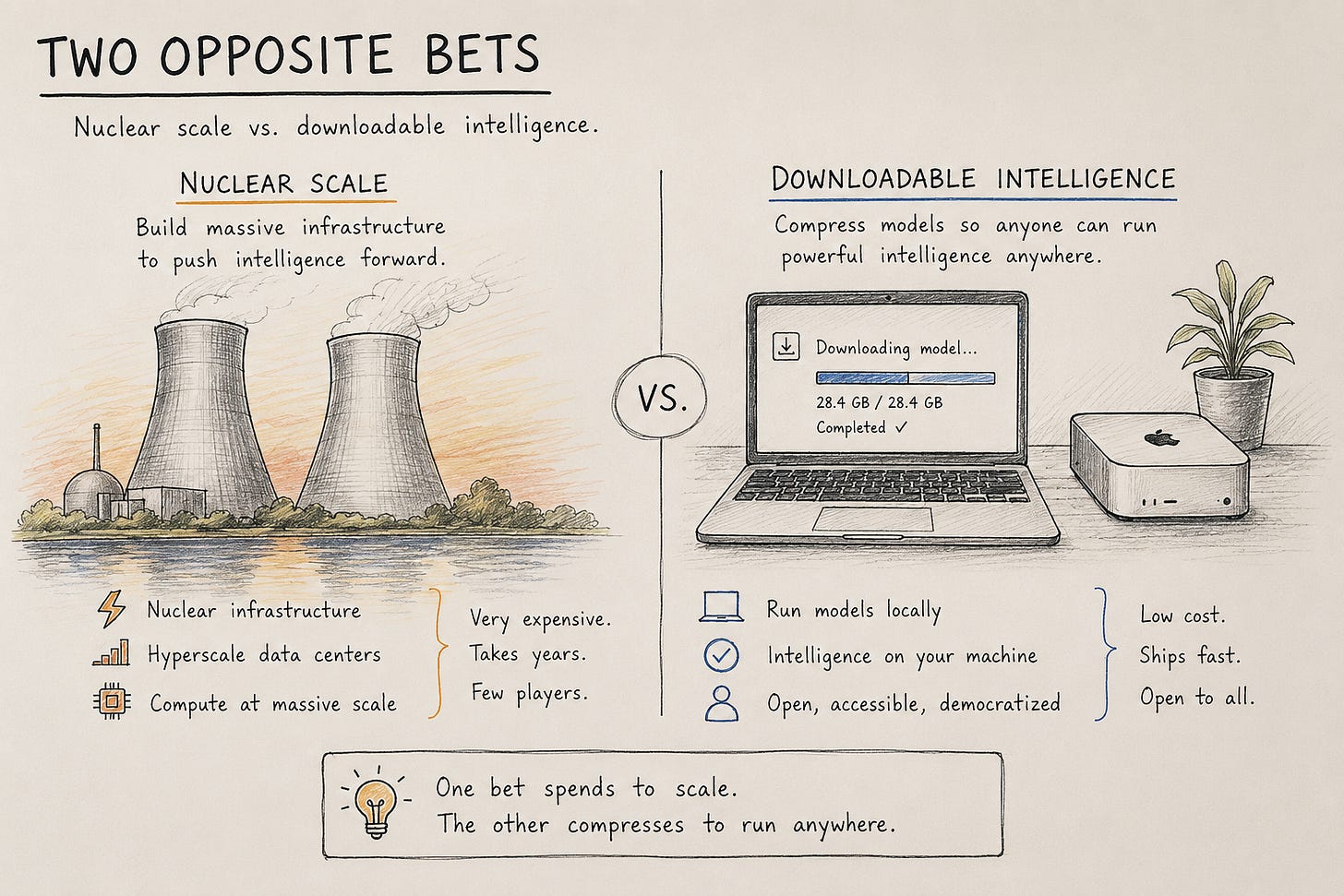
The question is: does intelligence have a ceiling?
The bet nobody names
Here is what that one question decides.
If the demand for intelligence caps if, for most of what people actually want, some model is eventually “good enough” and getting smarter stops mattering then the efficiency camp wins everything. Good-enough intelligence commoditizes, races toward free, and runs on a box you own. The value stops living in the model and moves to whoever delivers it cheapest per watt. And the half-trillion-dollar nuclear buildout becomes the most expensive stranded asset in history: power plants built for a demand that plateaued.
If demand is uncapped if every gain in capability just unlocks a new appetite, the way cheap steel never sated the hunger for steel but multiplied it then brute force runs for a decade. The frontier keeps pulling away, the last increment of intelligence is always worth paying for, and the downloadable models are a footnote chasing a line that never stops moving. The reactor-builders win, and the efficiency camp spent its genius optimizing a commodity nobody cared to own.
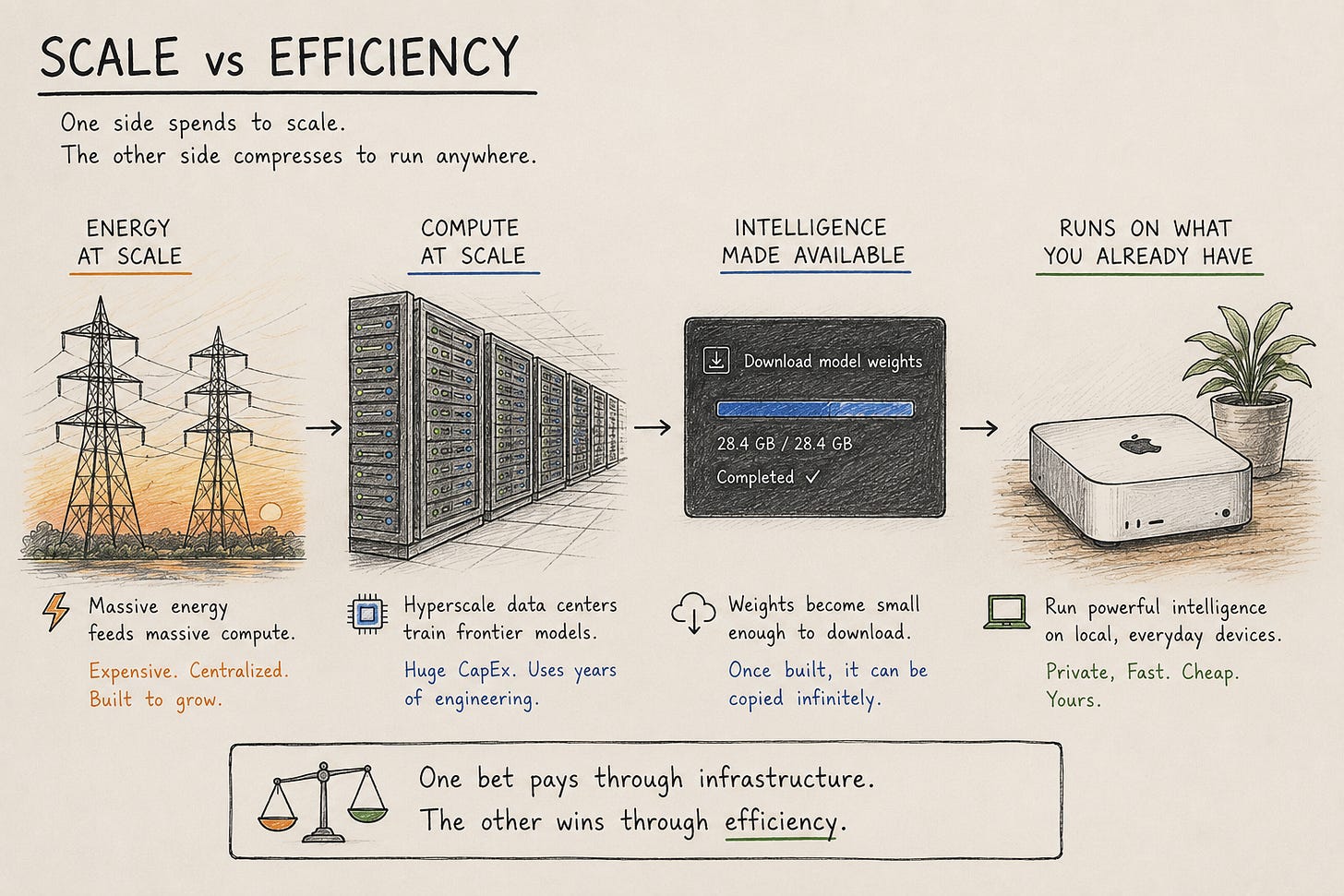
Same coin. Everyone in AI has bet their capital on one side of it. And the tell that this is a real bet, not a rhetorical one, is that the smartest money is loudly and expensively betting both sides at once which is not conviction. It’s a hedge against a question the industry hasn’t admitted it’s asking.
So which way does the coin land? We have exactly one prior. It ran for four billion years.
The one time this experiment was run
Biology hit a hard intelligence ceiling, and we know precisely what happened underneath it.
The brain runs on about 20 watts, a fixed cap, set by what blood can deliver and what a skull can shed. And under that ceiling, evolution did not build a bigger, hotter brain. It couldn’t: brute force was never on the menu, because a brain runs on foraged food with no wall to plug into, and there’s no mutation-sized step from a chemical membrane to a digital logic gate. So it was forced into architecture and every trick it found is one the AI industry is now scrambling to copy. It fires only a few percent of its neurons at once, because a single spike is so costly that firing more would burn the brain’s entire energy budget sparsity as a power bill. It fuses memory and computation in the same place, so it never pays to shuttle data across a gap. It spends most of its energy about twenty-seven to one over computation not on thinking, but on moving information down the wire.
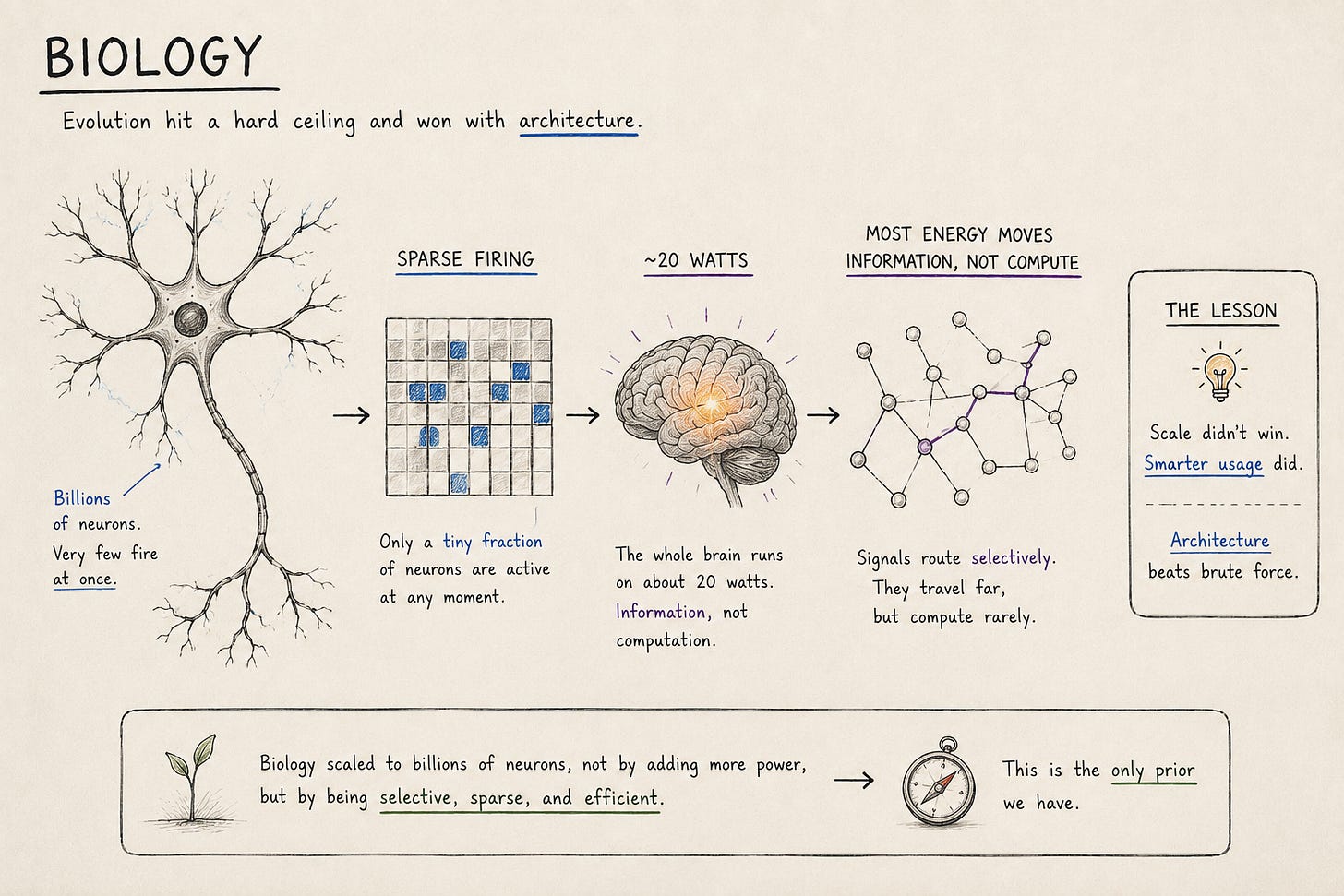
The verdict of the only run we have is unambiguous: under a fixed ceiling, architecture beats brute force. So if intelligence has a ceiling, biology already named the winner. The efficiency camp is betting with four billion years of precedent behind it.
And here’s the part that turns dusty precedent into this week’s headline.
The brain’s tricks are shipping, with model names
Why did five near-frontier models suddenly become things you can run at home? Because they are built on the brain’s first two tricks.
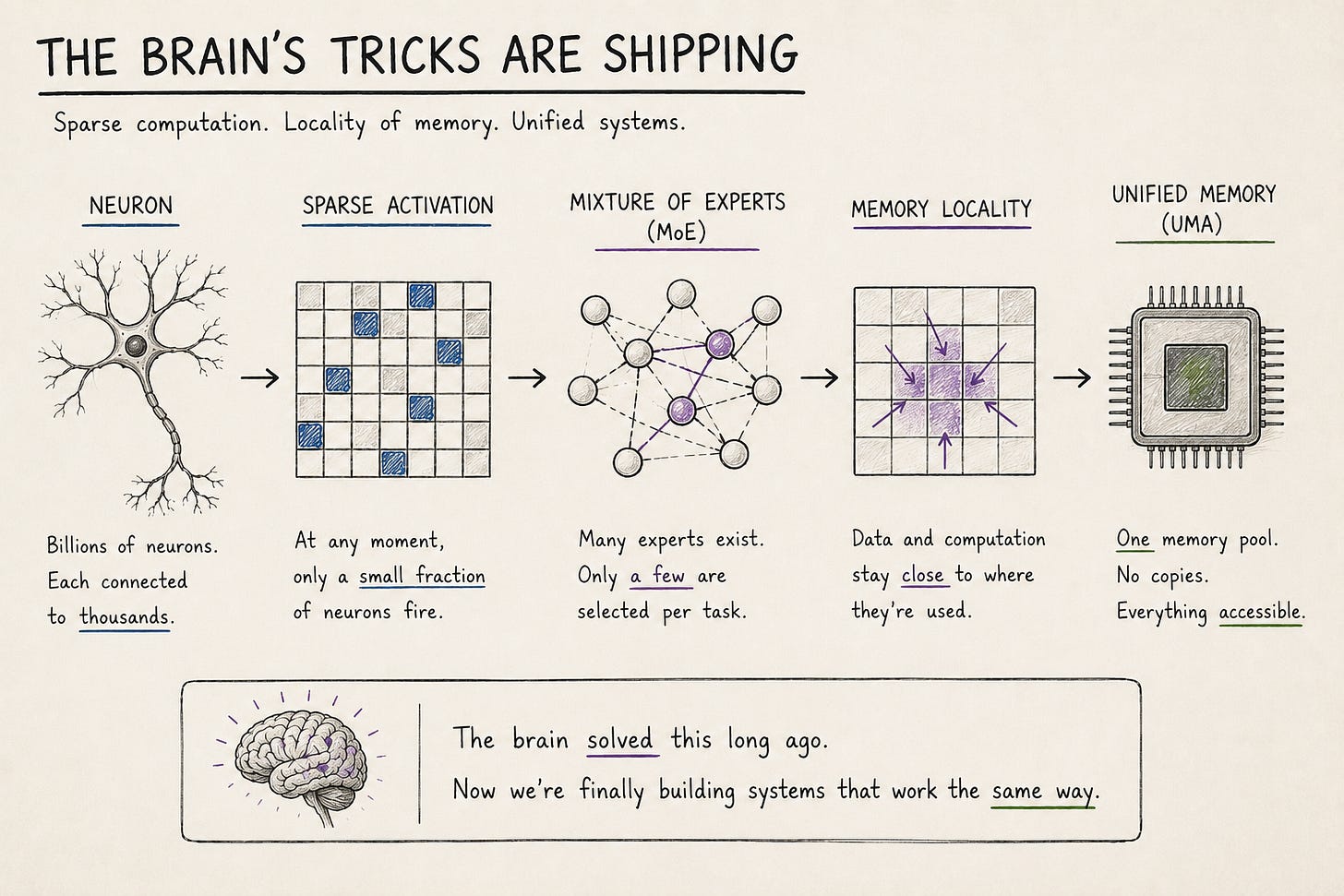
They’re sparse. Kimi K3 carries 2.8 trillion parameters but activates only about 50 billion per token a “mixture of experts,” hundreds of specialists of which a handful speak per word. That is the brain’s sparsity rendered in silicon: don’t light up the whole network, light up the sliver you need. It’s the entire reason a trillion-scale model can run on something that isn’t a data center.
And they win on locality. The reason these models run on a Mac and starve a traditional GPU rig isn’t compute it’s memory. Inference is bound by how fast you can move the active weights to the processor, not by arithmetic; the bottleneck is bytes, not math. The machines that run them well are the ones with memory fused close to the compute unified memory, shortening the wire. Which is the brain’s second trick, exactly: keep memory and computation in the same place.
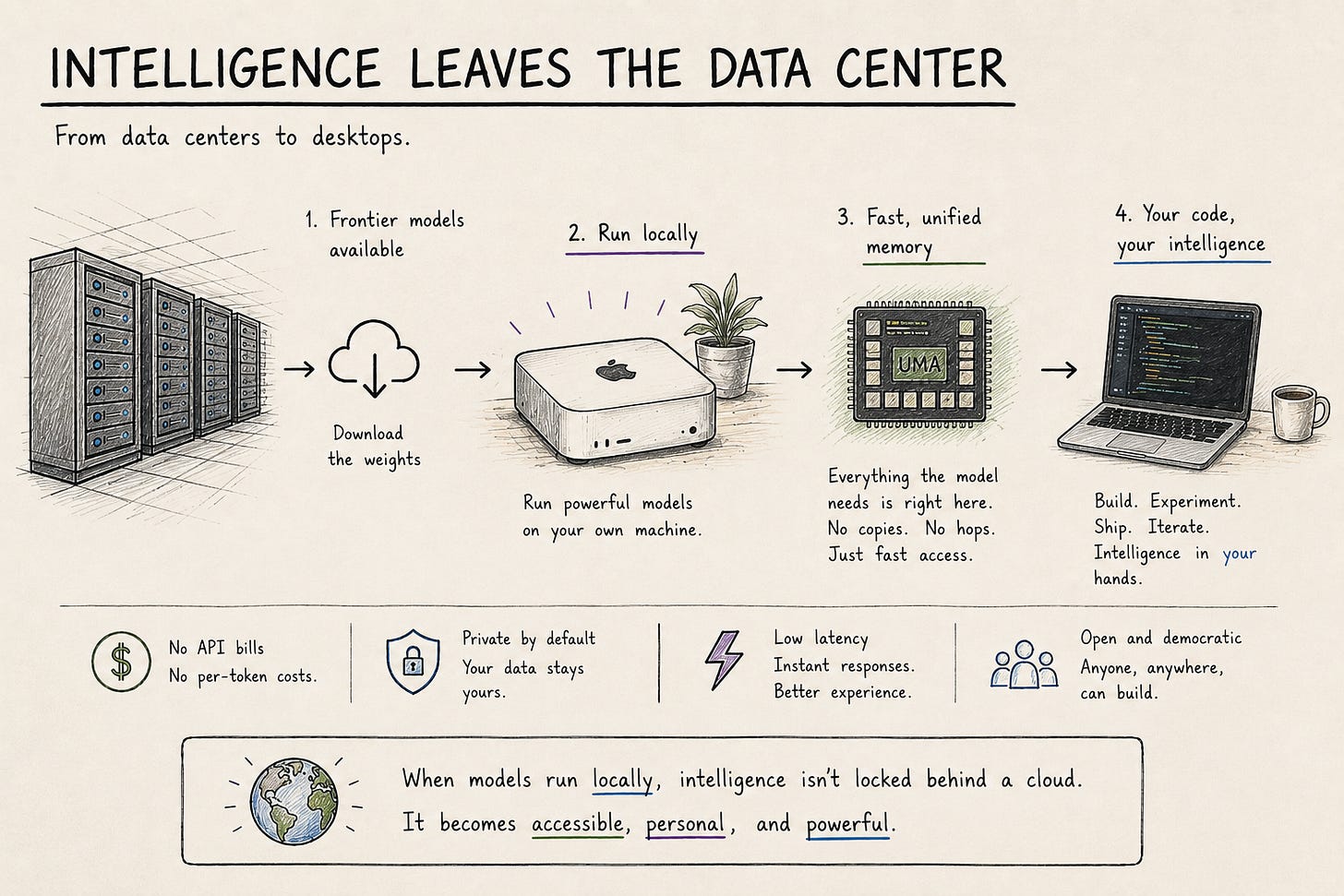
Neuron, mixture-of-experts-on-a-laptop, in-memory chip the same move at three scales: collapse the distance between where the data sits and where it’s used. The efficiency camp isn’t praying the architecture shows up. It shipped this month, with version numbers.
The tell in the venture money
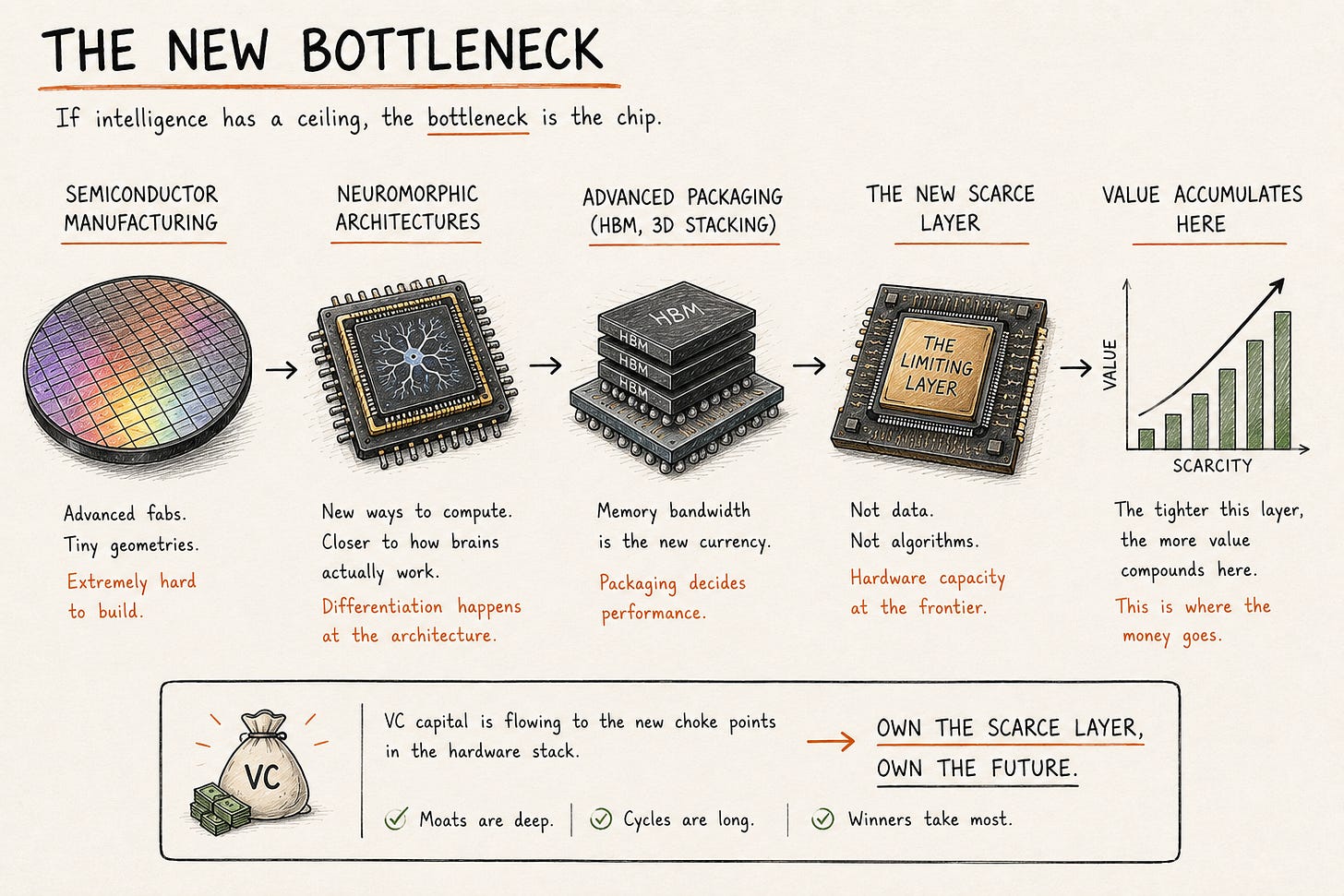
And the money that has no near-term reason to move is moving the same way. Between early 2024 and 2026, over $5 billion went into non-GPU, brain-shaped computing hardware against maybe $50 million of revenue a 110-to-1 bet on architecture over brute force, years before it can pay. The largest seed in the category’s history, $475 million, went to a founder whose whole pitch is the ceiling itself: we cannot produce enough energy to keep scaling, so the only way forward is to compute more per joule. That’s not a trade chasing this quarter. It’s nine figures wagered on the belief that the ceiling is real.
Where the bull case breaks
Now the honest part because the version of this argument that got reach this year (”intelligence goes free, the model layer dies, the giants are dead men walking”) bets the whole thesis on an assumption it never prices.
Look again at what the open models actually did this month. They took the middle, not the top. Every practitioner guide converges on the same routing rule: send the cheap, high-volume work to open weights, and keep the hardest, highest-stakes, most ambiguous work on the closed frontier. The gap closed to months on ordinary tasks and stayed double digits on the hardest ones. So intelligence didn’t commoditize. The legible part of it did the well-posed, gradeable, common work while the illegible frontier kept its margin.
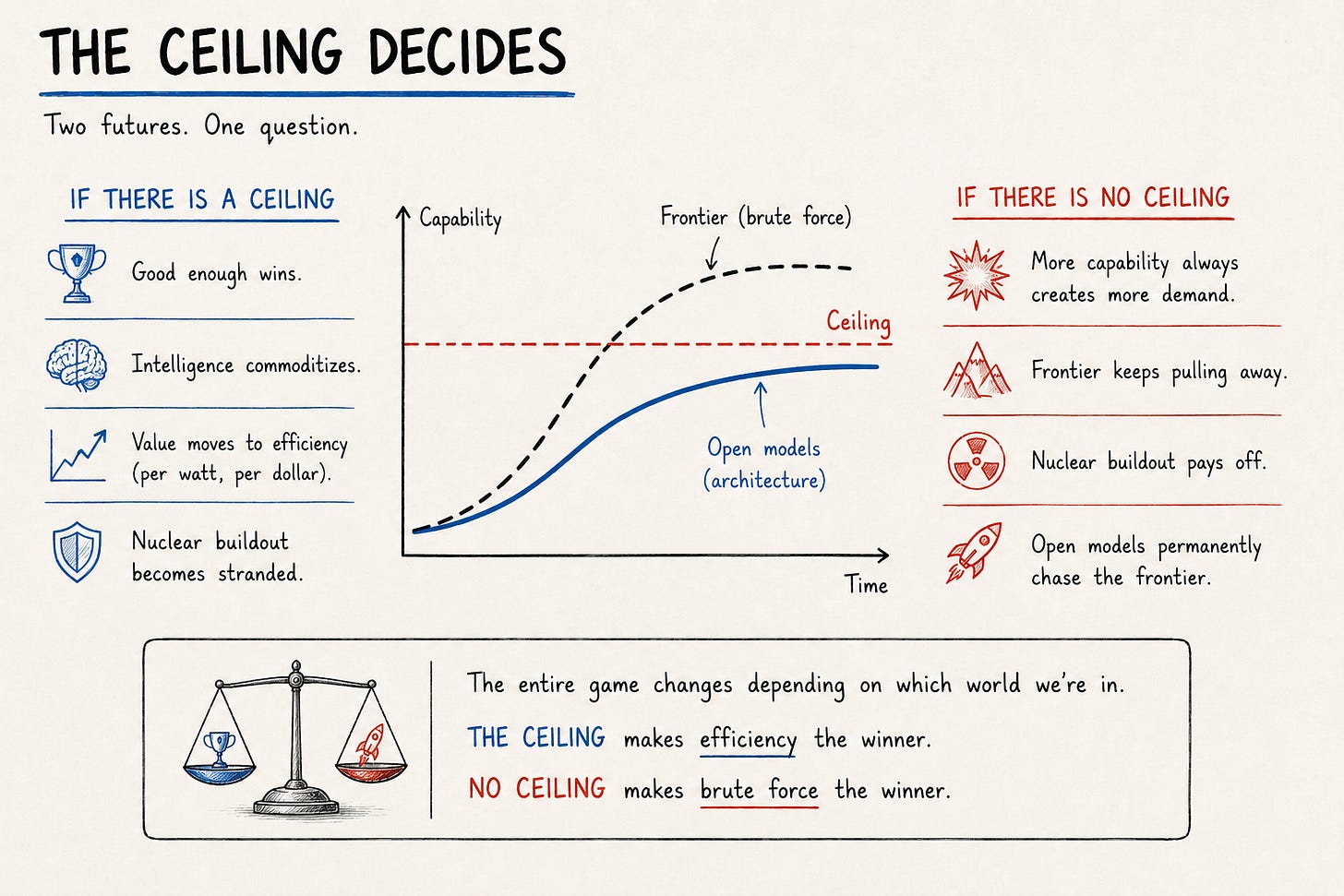
Which means the coin isn’t heads-or-tails. The ceiling isn’t a single wall; it’s a line, and the real question is where it sits. Below the line, intelligence is already free and running on your own silicon. Above it, the frontier keeps its rents. The entire trillion-dollar fight is over where that line settles and both camps are pretending it’s a binary they’ve already won.
The second ceiling
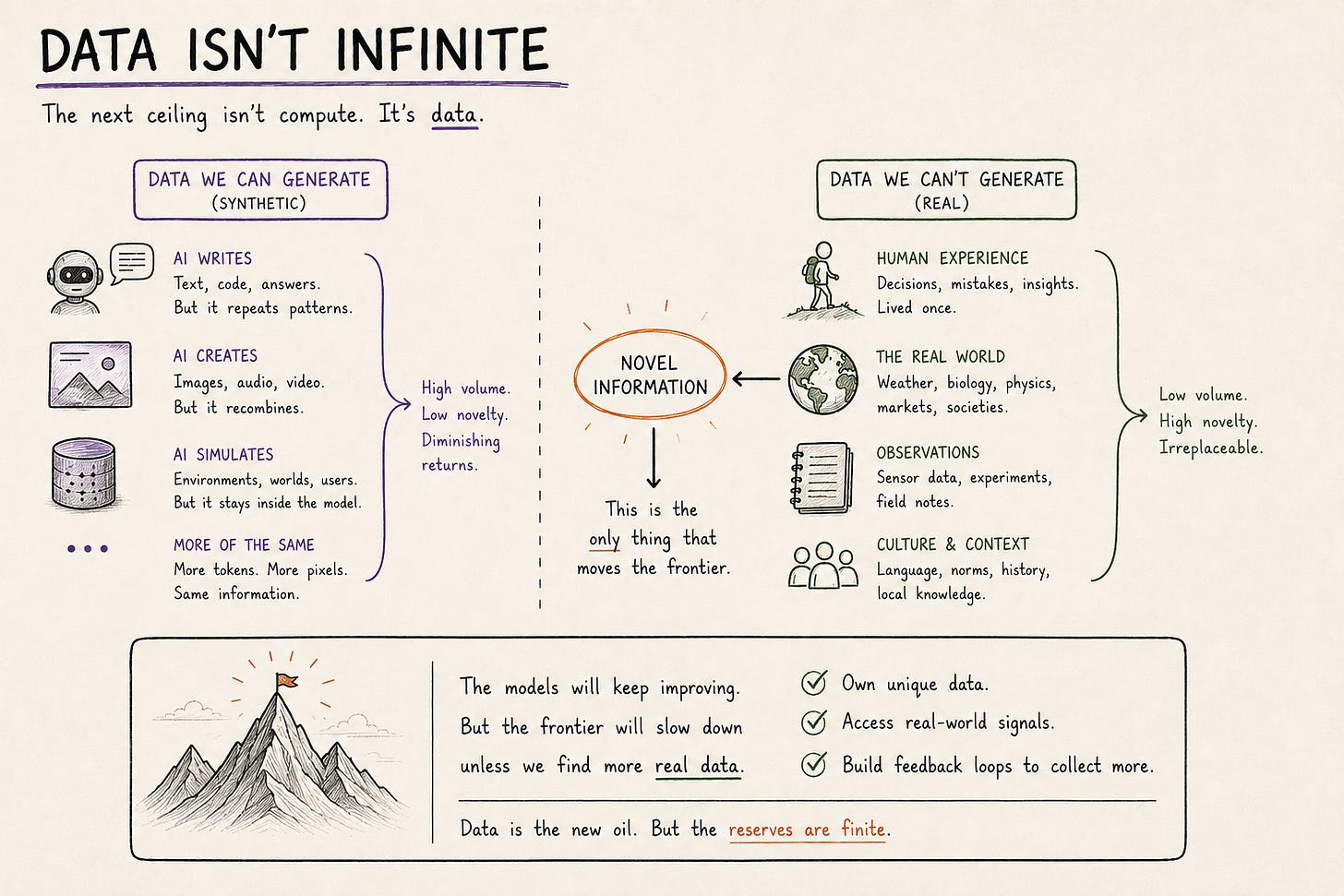
Energy was never the only wall, either. The brute-force bet needs three inputs compute, energy, and data and the third is draining in step with the first two. The stock of high-quality human text runs out between now and the early 2030s, and most new web text is already machine-generated, so each fresh scrape drinks its own exhaust. Feed a model its own output in a closed loop and it collapses. The energy ceiling is the buyable one enough capital annexes another gigawatt. The data ceiling is stubborner: you cannot mint fresh, uncontaminated human experience with money. Two ceilings, closing at once and biology cleared both with the same move, doing more per unit of the scarce thing, whether the scarce thing was a joule or a token.
What to actually watch
So don’t ask who’s right. Ask which uncertainty you’d rather own.
The efficiency camp is the convex bet: it wins outright if intelligence is capped, and it wins eventually even if it isn’t because runaway demand still meets a ceiling somewhere, and when it does, the efficiency gap is the only prize left to take. The brute-force camp only wins in the uncapped world, and only until it hits the wall biology hit. It also carries its own fat tail: it needs the demand to actually arrive. A reactor switched on in 2032 is a decade-long wager that the load shows up strand that demand, and the power plant is the thing that blows up.
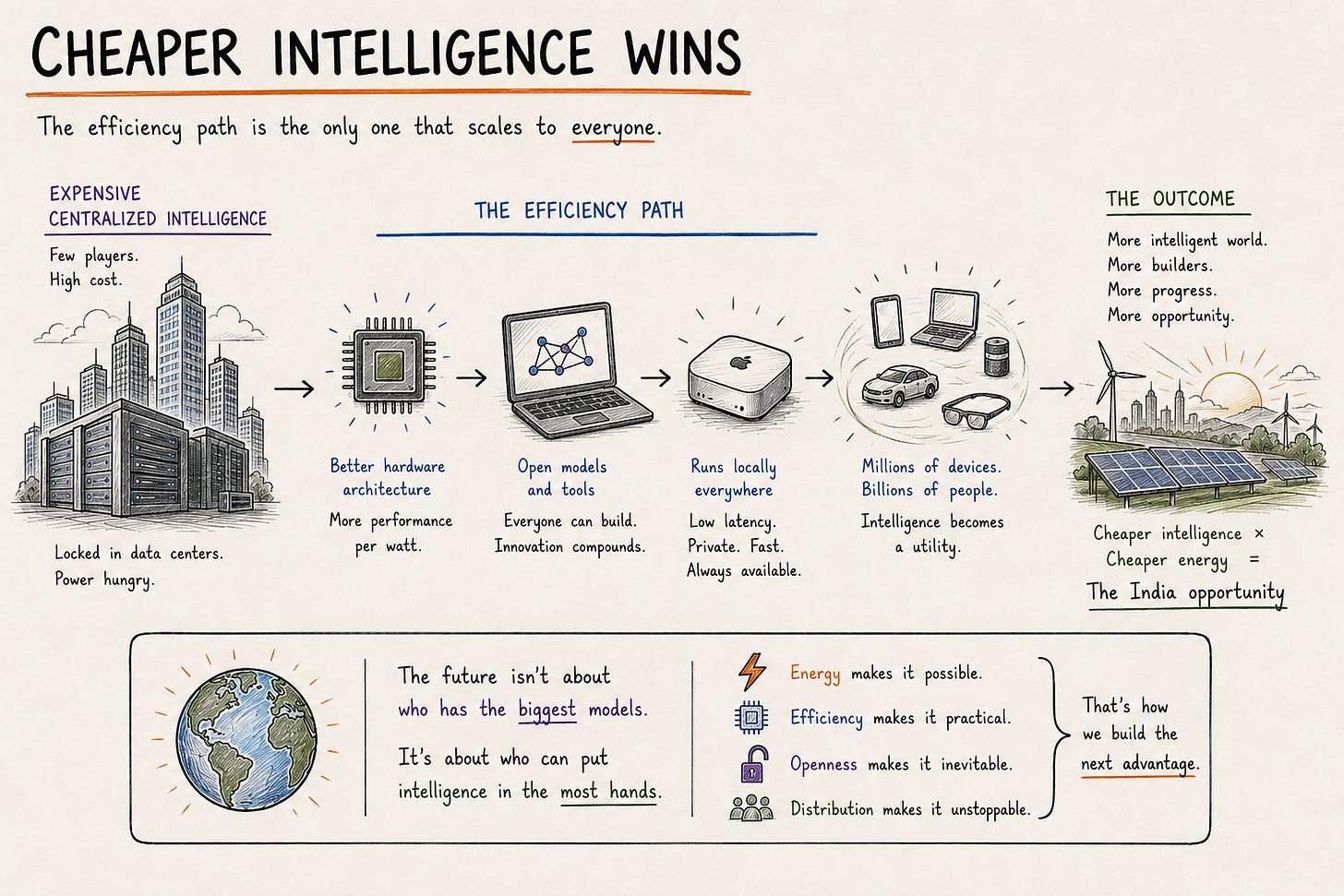
There’s a single number that reports the score in real time: whether the frontier holds its margin or the open middle keeps climbing into it. Watch where the line sits, and which way it’s moving. That’s the whole game and everyone has already bet on it, most of them without ever saying so.
Evolution ran this experiment once and filed the result. Half the industry is betting it holds. Half is betting this time is different. They just never told you that was the bet.