Finding a Flat in India Is Broken. We Have the Technology to Fix It. Nobody With Power Wants To.
On fake listings, misaligned incentives, and why the right home might already be three streets away from you.
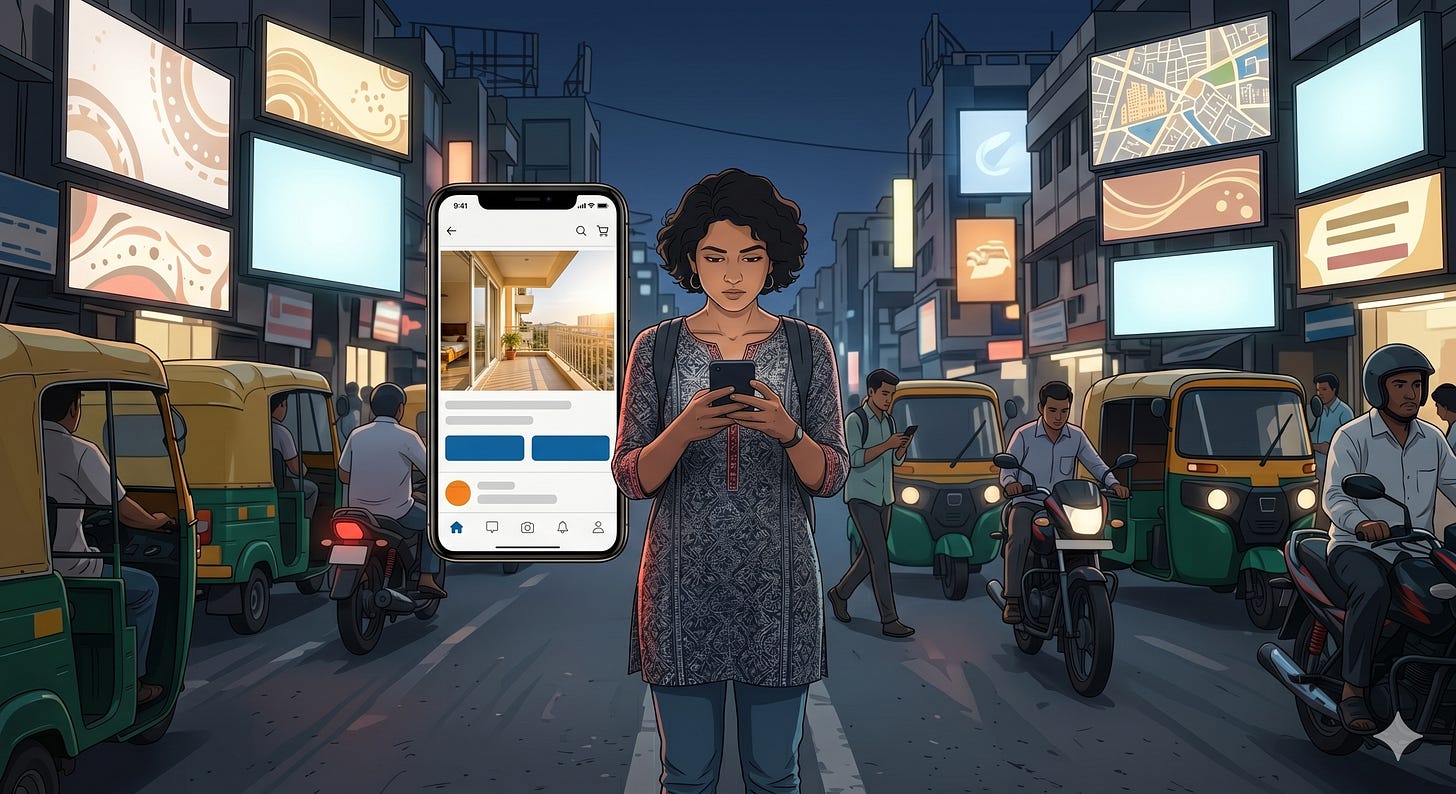
Picture this. You’ve just said yes to a job offer in a new city. Two weeks to figure out where you’re going to live. You open 99acres, find something that looks exactly right location works, rent is fine, there’s a balcony, the light looks good in the photos. You tap “Contact Owner.”
Within four minutes your phone is ringing from six different numbers.
None of them are the owner.
All of them are brokers. The flat just got taken, they each tell you. But they have something else, a little farther, a little more expensive. You should come see it this weekend.
You’ve been harvested. Whether the platform directly sells the lead or brokers aggressively distribute it among themselves almost stops mattering from the user’s perspective. Sometimes the listing exists. Often it doesn’t. The photos may be outdated or lifted from somewhere else. The rent is often just low enough to make you click. Once you did, the transaction was complete. The platform got paid. You got nothing.
Here’s the part that should make you genuinely angry: this isn’t a bug. It’s the business model.
Twenty Years and Basically Nothing Has Changed
99acres launched in 2005. MagicBricks in 2006. The iPhone came out in 2007. These platforms predate Google Maps having India on it, predate anyone using the word “algorithm” outside of a computer science classroom. They were built for a different world and structurally, they’re almost identical to what they were back then.
It’s not laziness. It’s incentives. These platforms don’t make money from you finding a home. They make money from brokers paying to access you. Every time you search, you’re the product. If they started verifying listings seriously, they’d lose inventory. Less inventory means fewer broker subscriptions. Fewer broker subscriptions means less revenue. So the fake listings stay up. Quietly. Deliberately.
If you want to see how far this has gone, look at the actual numbers. On 99acres today, 63% of listings come from brokers. Only 8% come from owners. Read that again, a platform that launched promising to connect you directly to property owners is now, in practice, almost entirely a broker directory. And broker billings are growing faster than any other revenue line. 99acres hasn’t drifted from its original mission. It completed a quiet transformation into broker SaaS, and it’s more profitable for it. The consumer was never really the point.
What’s remarkable isn’t that this happened. It’s that it lasted twenty years while everything around it got rebuilt from scratch.
India now has UPI, which processes more transactions monthly than Visa does globally. Aadhaar. ONDC. The country has shown it can dismantle and rebuild broken systems faster than anyone expects, when there’s will to do it. Real estate just happens to be the one sector where the incumbents are human, entrenched, and loud enough to hold their ground.
The Broker Isn’t Actually the Problem
Most people building in this space get this wrong: the broker isn’t the enemy. The broker exists because someone has to carry local knowledge, and right now nothing else does.
Think about what a good broker actually knows. Which building has water problems every monsoon. Which landlord will make your life difficult if you have guests over. Which “2BHK” is really two rooms separated by a curtain the previous tenant rigged up. Which housing society has a committee that quietly rejects certain tenants for reasons no one says out loud. That knowledge is real and genuinely valuable. It just lives entirely inside human heads because no platform has ever bothered to capture it.
That’s why people still pay a month’s rent to someone they met twice, even when they’re angry about it. Because showing up to a flat without that context and signing a lease that locks you in for eleven months, is genuinely scary. The broker, for all his flaws, reduces that fear.
The problem isn’t that brokers exist. It’s the gap, between everything a city knows about its own housing stock and what you, searching from your phone on a Sunday evening, can actually get to.
AI doesn’t fix this by replacing the broker. It fixes this by making the broker’s information available to everyone, not just the people who happened to find the right middleman.
What “AI in Real Estate” Actually Looks Like
When companies say they’re doing AI in real estate, they usually mean there’s a chatbot sitting in the corner of the page that says “Hi! How can I help you today?” That’s not AI in real estate. That’s a costume.
What it actually looks like: a platform that knows which localities flood every July. That gives you a real commute time to your office, not the optimistic Google Maps estimate from 10am on a Tuesday. That lets you type:
“I need a 1BHK near Whitefield, I work late so cab availability at night matters, I can’t do a 45-minute commute, my budget is ₹18k but I’d go to ₹22k for something genuinely good”
and actually understands what you mean, instead of showing you a dropdown menu designed in 2007.
Zillow in the US already runs a system where your query gets broken into pieces by an AI, routed simultaneously to specialised models, one for valuation, one for location data, one for neighbourhood context and reassembled into a real answer. Redfin has had conversational search for a couple of years. None of this is experimental anymore. What doesn’t exist in India is someone putting it together into something actually built around the person searching, rather than around the broker selling.
The ₹80,000 Problem Nobody Talks About
Here’s a number that doesn’t come up enough: ₹80,000.
That’s roughly what a young professional pays upfront as a security deposit for a decent 1BHK in Bengaluru right now. Cash transfer. No escrow. No receipt that holds up anywhere. To someone they’ve met once.
The New Rent Rules of 2025 cap deposits at two months’ rent. Landlords routinely ignore this. And even when they follow it, there’s nothing protecting that money once it leaves your account. Landlords deduct for repainting walls that were already peeling. For wear and tear on appliances that arrived broken. For things that were never documented because nothing was documented when you moved in.
Deposit disputes are one of the most common, most infuriating things in Indian urban life, and nobody in PropTech is seriously trying to fix them.
But the fix is also the business model which is the part nobody seems to have noticed. Hold that deposit in an RBI-compliant escrow account, accessible only through a verified process at the end of the tenancy. Both sides are protected. The platform holds a float across thousands of active leases and earns interest on it. For people who can’t afford two months upfront which is a lot of people moving cities on their first real salary there’s now an IRDAI-backed surety bond framework that allows zero-deposit leasing. The tenant pays a ₹5,000 annual premium. The insurer covers the landlord against default. Everyone wins. The platform takes a commission.
Nobody is doing this seriously. Not because it’s hard. Because the incumbents are too comfortable to look up.
Every Platform Eventually Becomes the Thing It Set Out to Destroy
It’s worth pausing on a pattern that shows up so consistently in tech that it should probably have a name by now.
Social media was built to connect people. It still does, but through an algorithm optimised entirely for attention, because attention is what advertisers pay for. The platform’s interest and the user’s interest quietly separated somewhere around 2012 and have been drifting apart ever since.
OTT came to rescue us from cable, no ads, no forced bundles, just the shows you wanted. Then Netflix crossed 200 million subscribers and realised advertising was too big to walk away from. The ads came back. The bundle is coming back. The thing cable was is slowly being rebuilt, just with a better interface.
Dating apps might be the most honest version of this. A dating app that actually worked, one that reliably helped people find relationships, would eventually have no users left. The whole revenue model depends on people staying single, staying on the app, swiping again tomorrow. So the apps get tuned, in ways that are subtle and hard to prove, for engagement over outcomes. Keeping you on the app is worth more than getting you off it.
NoBroker is this story told in Indian PropTech. And it’s important to be fair here, because the easy version of this argument is wrong. NoBroker didn’t fail. It became a unicorn. Millions of people use it. It genuinely changed what Indian renters expected from a property platform, that alone is a real thing. What NoBroker proved, first and most clearly, is that the hunger for something better was absolutely real.
What it also showed, more slowly, more uncomfortably, is how hard it is to keep your incentives honest once you start scaling. It built its name by cutting out the broker. Then it needed to grow, and growth needed revenue, and revenue meant charging upfront for a subscription before anything was delivered. The moment the platform got paid before the outcome, the urgency to deliver the outcome loosened. By the time the reviews came in, NoBroker looked a lot like what it set out to replace a centralised, digital middleman that takes your money first and figures out your problem second.
Nobody planned it that way. Success just created the conditions. Scale needs capital. Capital needs growth numbers. Growth numbers reward volume over quality. And volume, in any marketplace, almost always means eventually letting the brokers back in through the side door.
That’s the trap anyone building here has to consciously design around from day one not just intend to avoid, actually build against. Because the pressure of metrics and investor expectations will always pull toward extracting from the user’s desperation rather than from their success. The only real defence is to make those two things the same thing. You make money when someone finds a home. If they don’t, you don’t. Everything else is just a slower drift toward becoming the thing you promised to replace.
Who This Is Actually For
The person this should be built for is 24 years old and just moved from Jaipur to Pune for their first real job. Uses ChatGPT more than Google. Has never written a cheque. Expects apps to work the way they think, not the way someone designed a database in 2005.
Also quietly livid. Paid one month’s rent to a broker to find a flat they found themselves. Got eight spam calls within minutes of a single search on 99acres. Transferred ₹60,000 to a landlord they’d met once, and a WhatsApp screenshot is the only proof that transaction happened.
There are millions of them. India’s internal migration is happening at a scale the housing stock can’t absorb and the current discovery system genuinely can’t serve. This is the first generation to grow up expecting technology to just solve things and real estate might be the first time they’ve run into a wall where the technology exists, works, and nobody with an incentive to use it properly actually will.
The structural picture is getting worse, not better. In Bengaluru, 65% of demand sits below ₹1.5 crore. New supply is increasingly priced above it. Developers aren’t building what people need because premium inventory is where the margins are. NoBroker’s own research says 42% of Bengaluru buyers are now effectively priced out of new launches. So they push into resale and rental which is more opaque, more broker-dependent, and harder to navigate than primary sales. The people who need the most help are being funnelled into the most broken part of the market.
Underneath this is a shift that’s harder to see but important. Real estate in India’s metros is getting financialised. Investors who bought between 2020 and 2023 are sitting on 60–80% appreciation and starting to sell. Once housing becomes a wealth instrument rather than shelter, developers start optimising for investors, not residents. Apartments get bigger, branding goes luxury, prices move up. The people just looking for somewhere decent to live get left behind in a market that quietly stopped being designed for them.
That gap between what this generation expects and what they’re actually getting isn’t closing. It’s widening. Which is where the whole opportunity sits.
So What Happens Now
Someone will build this. It’s really just a question of when and who.
NoBroker’s losses look like a warning if you read them wrong. The right read is the opposite. NoBroker proved the demand was real and enormous that people would pay, switch platforms, tell their friends, if someone built something genuinely better. What it couldn’t hold onto was its own incentive alignment as it scaled. That’s not a market problem. It’s a design problem. And design problems can be solved.
What the working version looks like isn’t complicated: inventory verified before it goes live, not after someone complains. An interface that actually understands what you need. Fees that show up only when a lease gets signed. A deposit sitting in escrow rather than in a stranger’s account waiting to become a dispute. Not a radical idea. Just one that requires caring about the person searching and structuring the business so that caring and making money point in the same direction.
India has rebuilt harder things. Real estate just hasn’t had its UPI moment yet. When it does, the whole apparatus the fake listings, the spam calls, the bait-and-switch, the deposit fights doesn’t collapse dramatically. It just quietly becomes unnecessary. The way every middleman who controlled information became unnecessary once the information got free.
The flat that’s right for you might already be three streets away. You just don’t know it yet, because the system was never actually designed to tell you.
Building in this space, thinking about it, or just fed up after your last flat hunt