Writing
Essays when I've thought something through. Notes when I haven't yet, but don't want to lose the thought.
Every piece in this series looks at one part of a machine: the chip, the memory, the heat, the grid, who got paid. This one steps back to ask why the machine is being built at all. The answer is usually called a race: a handful of companies each spending more than most countries to build the most capable AI first. That picture is right but incomplete. Building the smartest model is only the first of five races, and it is no longer the one that settles who wins. The other four are about what happens once a model exists: who can get the compute to run it, who can make it reliable enough to hand a job to, who owns the customers, and who can turn a dollar of computing into more than a dollar of work.
Get friendly with the AI race
It looks like one race to build the smartest model. It is five: capability, compute, deployment, distribution and economics, with nations and safety wrapped around all of them. A plain guide to the whole machine: who is racing, what the words mean, who pays whom, and what comes after.
Read, 14 min →
Nineteen Public Keys
A swarm of AI agents rebuilt the internet’s communication stack in four days. They got to the last layer and hit the same wall we did.
10 min →
AAA-Rated GPUs
Wall Street just agreed to insure Nvidia’s downside. Once you see the shape of the trick, you start seeing it everywhere else too.
5 min →.jpg?width=480)
What becomes scarce when intelligence becomes cheap?
Every time something becomes abundant, the value moves next door. A search for the next door.
the bottleneck always moves next door
3 min →AI Has Passed Every Exam. It Has Never Had an Idea.
The machine has passed every exam we can build and discovered nothing.
9 min →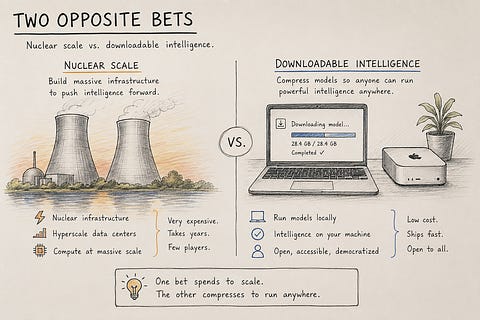
What Becomes Scarce After Intelligence?
Nuclear reactors and downloadable models look like opposite strategies. They’re two sides of one wager on a question nobody will say out loud: does intelligence have a ceiling?
7 min →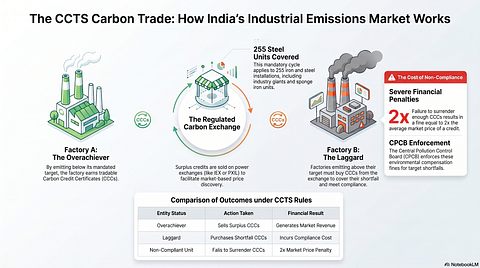
India’s Carbon Markets : A New Test for Global Climate Policy
Part one of three on carbon credits, India’s compliance market, and where the money will actually go.
7 min →
Google Wants AI to Become Boring
Why Google may be trying to make intelligence disappear.
8 min →
The Wall That Wasn’t Yours
Fable 5 is Anthropic’s best model, but Friday’s letter showed why 'best' doesn’t mean valuable
7 min →
The Rate-Limiting Step
How AI keeps solving the wrong bottleneck
6 min →
The Speed of Being Wrong
Whether AI levels you up or quietly hollows you out comes down to a single variable almost no one is naming. It is not your skill.
9 min →
Uber Burned a Year of AI Budget in Four Months. A Rat Catcher in 1902 Knew Why
Big Tech turned AI usage into a metric and a 124-year-old bounty scheme in colonial Hanoi explains exactly what happened next.
7 min →
Finding a Flat in India Is Broken. We Have the Technology to Fix It. Nobody With Power Wants To.
On fake listings, misaligned incentives, and why the right home might already be three streets away from you.
10 min →
Why We Can Never Have Good Social Media
How AI advertising is driving culture underground and why the places that feel authentic today are only safe until someone notices them.
5 min →
Gen Z Is Going Offline
What looks like a generational preference for offline socializing is a market signal about the failure of retention-based business models. Gen Z isn’t rejecting digital tools. They’re leaving platform
6 min →notes, roughly in order
What is a moat when the model isn't yours?
Mac developers have a verb for this: to get Sherlocked. In 2002 Apple shipped Sherlock 3, which did most of what a popular third-party app called Watson did, and Watson's business went away. The platform owner looked at what was selling on top of it and built it in.
The problem-selection premium
Richard Hamming used to ask scientists at Bell Labs what the most important problems in their field were, and then why they weren't working on them. People didn't like the question. It was a good question because working hard on the wrong problem is the most common way for smart people to waste a career.
Same model, different wiring
When factories electrified, every one of them got the same current from the same grid. For decades productivity barely moved. The gains came only when owners stopped swapping a big motor for the old steam engine and redesigned the floor around small motors at every machine. Same power, different wiring, very different results.
Selection is the new bottleneck
Photographers used to shoot a roll of 36 frames, print them all on one contact sheet, and circle a single one in grease pencil. The shooting was hard, but the circle was the craft. Plenty of famous photographs were chosen from a sheet of near misses.
The convergence tax
Ask three well-run companies to use the same frontier model to answer "what should our product strategy be?" and you get three versions of one memo. Nobody did anything wrong. The inputs were the same, so the outputs regress to the same place.
The luxury of reality
When factories made goods cheap, the handmade thing didn't disappear. It moved upmarket. William Morris and the Arts and Crafts movement made a whole aesthetic out of what machines couldn't do. A century later, "hand-stitched" is something brands print on the label.
The non-technical technical advantage
Most value in technology gets lost in translation. An engineer knows what a capability can do. A founder, investor or operator knows what a market will pay for. Very few people can walk the whole chain without falling off:
The verification economy
England has required silver to be tested and stamped since 1300. The stamp was tiny and it did one job: it told a stranger the metal was what it claimed to be. Once there is enough cheap imitation around, that little mark is the difference between metal and money.
The first version of this room
The first version of this site was a weekly AI news edition. It had Renaissance paintings with object-detection boxes drawn over them, a chip that booted up on the loading screen, and a hero image that "denoised" itself like a diffusion model.
The aura dividend
In 1935 Walter Benjamin argued that mechanical reproduction strips a work of art of its aura: its presence in one time and place. He was right about the aura and wrong about what would happen to its price. A century of perfect copies has made originals more valuable, not less.
Distribution is rented attention
When people say a startup has distribution, they usually mean it has found a cheap way to reach people through someone else's surface: a search engine, an app store, a feed, a marketplace. That is real, but it is a lease, and the landlord reads the same numbers you do.
The Convergence Test
Biologists call it convergent evolution: unrelated lineages arriving at the same form because the environment rewards it. Haeckel's anemones are a hundred species solving the same problem the same way. The claim that AI products are converging is easy to make and hard to check. This benchmark is an attempt to check it.
Anatomy of an AI startup
Vesalius's plate is a useful picture of a lot of AI companies: an impressive, detailed body hanging from a single rope it doesn't own. This analysis takes the body apart, layer by layer, and asks of each: could a well-funded competitor with the same model copy this within a month?
Six shocks to expertise
A short history of expertise getting cheap, told as six moments. For each one: what became cheap, and what became valuable as a result. The pattern is consistent enough to be suspicious of, which is a good reason to write it down.
The rhinoceros problem
In 1515 an Indian rhinoceros arrived in Lisbon. Albrecht Dürer, in Nuremberg, never saw it. He worked from a written description and a rough sketch someone sent him, and produced a woodcut so convincing that for more than two centuries it was what Europeans thought a rhinoceros looked like.