we need to talk about the ai situationships
Imagine investing billions in someone, charging them billions for the stuff they need to survive, and then watching them build a replacement for you. Welcome to the AI industry.
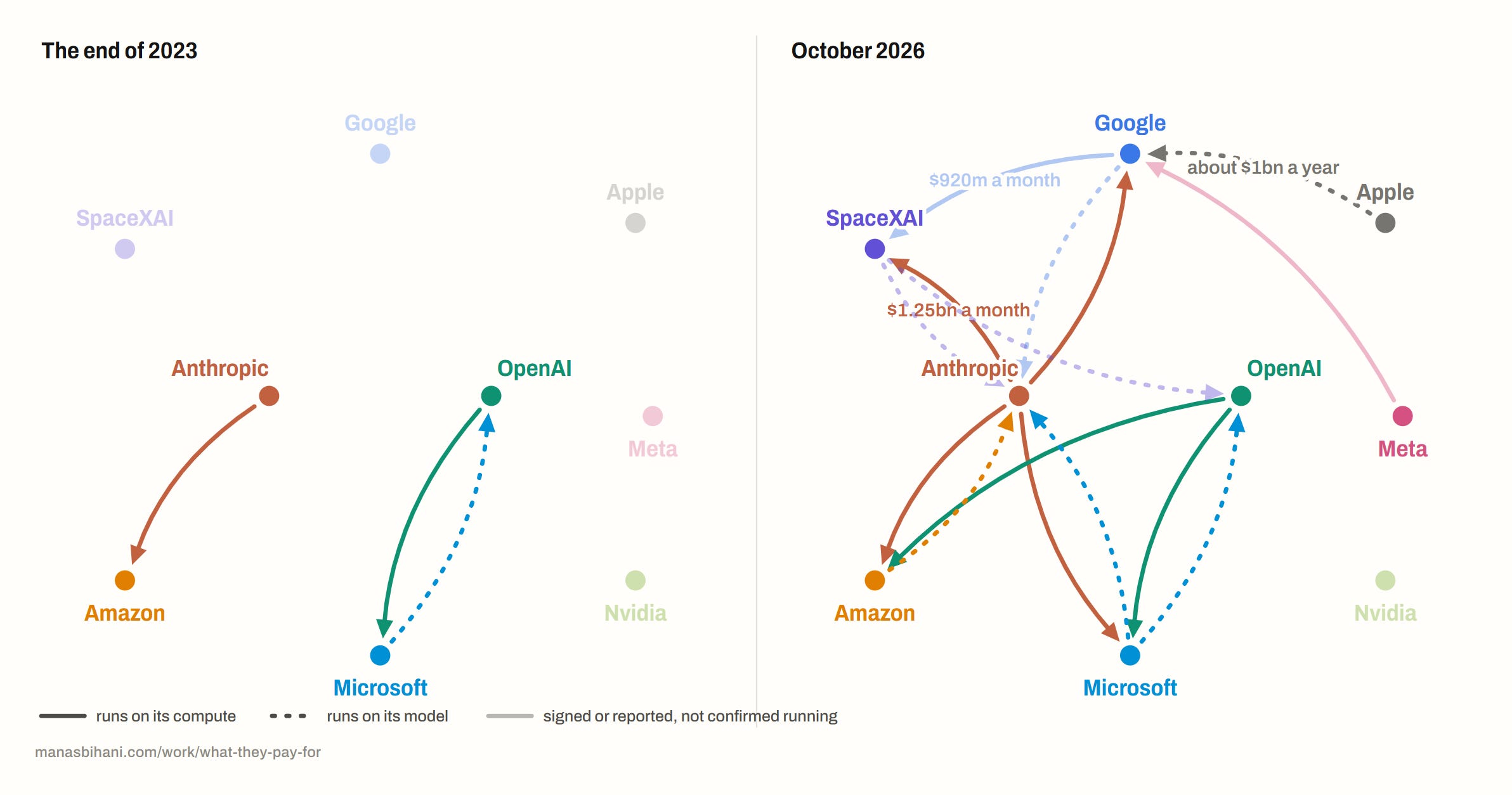
At the end of 2023 there were three ties on this chart, and everyone knew what they were. Microsoft and OpenAI ran on each other. Anthropic ran on Amazon. That was it.
There are fifteen now, ten of them confirmed running, and that was before this month. A few highlights:
Google owns more AI computers than any company on Earth. It rents 110,000 more from SpaceX, which until recently was a rocket company, for $920m a month.
Anthropic makes the model businesses pay the most for. It runs on computers rented from four companies on this chart, including SpaceX, whose own lab builds a rival, at about $1.25bn a month.
Microsoft owns about 27% of OpenAI. It built its newest work agent on Anthropic’s technology.
Apple makes the iPhone and rents the brain: Siri runs on Google’s Gemini, at a reported $1bn a year, on Google’s servers.
Then, in one week this October, OpenAI started selling its models through Google’s cloud, where Claude already sells. The next day Anthropic moved its whole platform in. The two labs fighting Google’s Gemini now both sell through Google’s shop. Apple and Meta, whose bosses clashed for years, announced a joint project. Tesla and SpaceX set up committees to discuss getting married.
Nobody will say what any of this is. So this page reads what they pay for, because a keynote costs nothing and a ten-year contract does. It follows nine companies through 186 dated decisions. Compute means the computers AI is trained and run on. A lab builds AI models, and a cloud rents computers to others.
The cast, in one line each:
Google: Owns everything. Still short. Rents from Elon Musk.
Microsoft: Owns a quarter of OpenAI. Builds its newest agent on Anthropic. Is building its own chip so it needs Nvidia’s less.
Amazon: Anthropic’s biggest backer. Quietly gave up most of its own models. Blocks other companies’ shopping agents at the door.
Meta: Gave its models away for years, then kept its best one. Now runs one on Apple’s Macs.
Apple: Owns the phone, rents the brain.
OpenAI: Signed early and for everything. Now on every cloud, including its rival’s.
Anthropic: Waited, then signed with everyone. Its landlords include a competitor.
SpaceXAI: Was a rocket company. Became a landlord. AI is now its biggest business.
Nvidia: Sells the chip everyone is trying to stop buying, and funds the people leaving.
Why wasn’t one partner enough?
In 2023 everyone was fighting over the model. OpenAI released GPT-4 in March, and for the next year the only question anyone asked was whose model was best. Microsoft put $10bn more into OpenAI. Google merged its two research labs. Amazon put up to $4bn into Anthropic. Elon Musk started a lab of his own.
Compute was the boring part. A lab got it from its cloud, like electricity. When Anthropic took Amazon’s money, it made Amazon its main supplier in the same announcement, and that was the entire compute plan.
Then the clocks went out of sync.
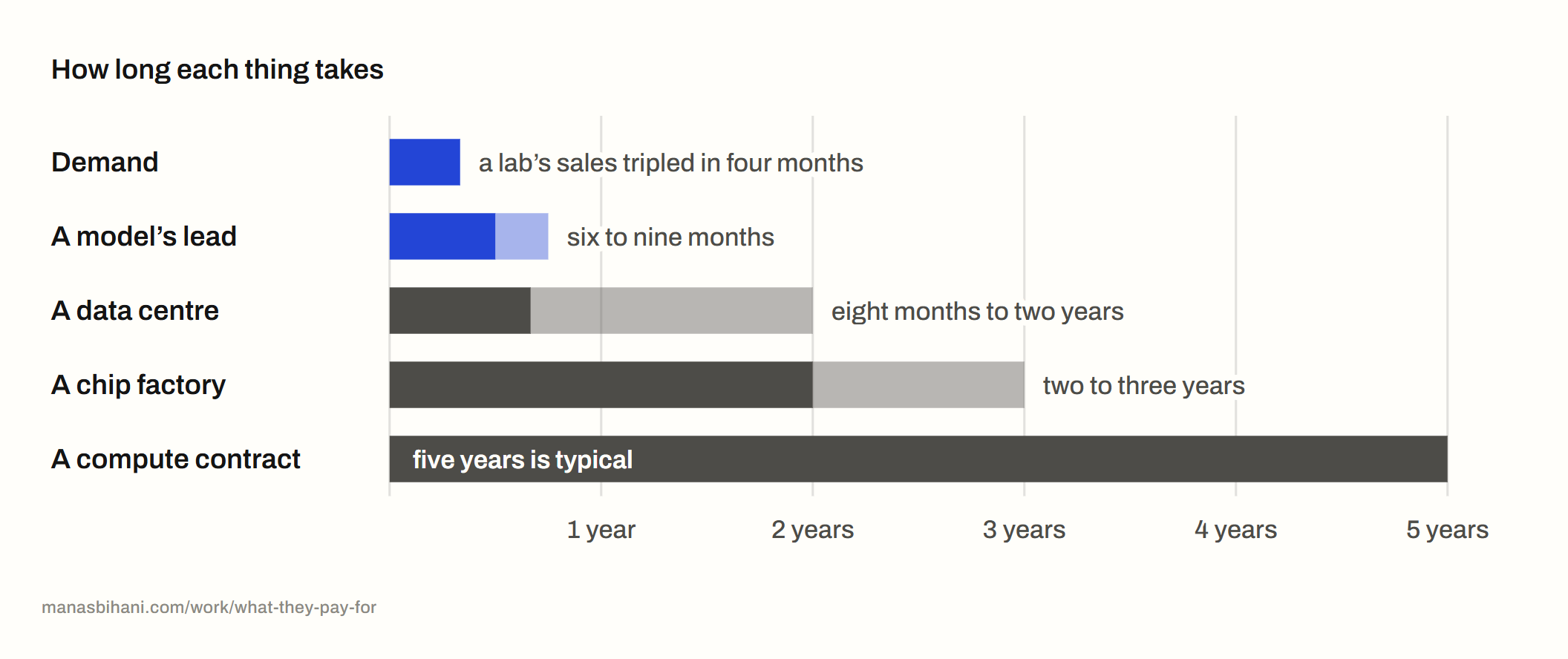
Demand for a good model can triple in a season. The building to serve it takes a year or two. The factory that makes its chips takes two or three, and the contract that pays for it all usually runs five. So every company had to guess how much compute to sign for long before it knew how much it would need. Anthropic’s chief executive put the stakes plainly: “if you’re off by a year, you go bankrupt”.1
Everyone guessed low. Renting a single Nvidia H100 for an hour was supposed to get cheaper as newer chips arrived. It went from $1.70 to $2.35 in five months, by SemiAnalysis’s index. Old chips getting more expensive is not what a healthy market looks like. What has been short, and when, is in a fold below.
What do you do when you can’t get enough?
You go to whoever has some, and you take their terms. Nobody on this chart won a bet on AI compute. The companies that own it already had it.
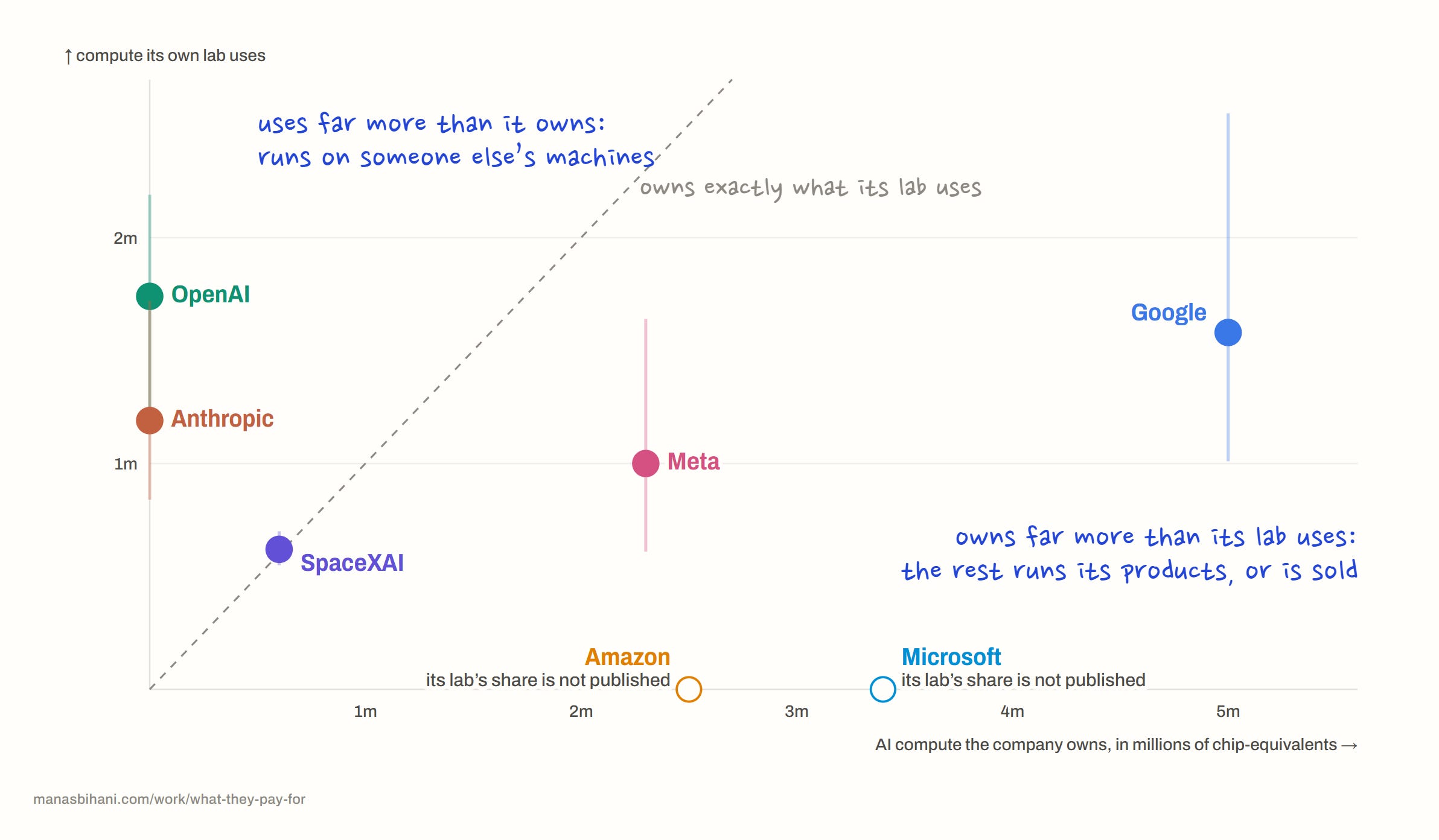
Google, Microsoft and Amazon spent a decade building data centres to rent out. Meta built its own to run its apps. When AI arrived, they had the buildings, the power and the chip orders. OpenAI and Anthropic had a model and no machines. That’s why they sit high on the left: they use an enormous amount and own almost nothing.
Even the landlords ran short. Microsoft has $329bn of leases that haven’t started. Meta rents from CoreWeave and Nebius. Google rents from SpaceX. Six of the nine say on the record that they are still short of compute, including the three that own the most.
The two labs dated very differently. OpenAI signed early and for everything. It was running 1.9 gigawatts at the end of 2025 and has signed for up to about fifteen times that, mostly on five-year terms.2
Anthropic waited. Its chief executive said he wouldn’t bet the company on a forecast. Then demand arrived all at once, its coding tool kept falling over, and in eleven months it signed six compute contracts, one of them for an entire data centre SpaceX had built for its own lab. It also asked Meta. Meta said not right now. Waiting didn’t slow it down: by July Anthropic was selling at $65bn a year.3 What it changed was the terms. Nearly half of Anthropic’s 2025 revenue came through Amazon’s and Google’s clouds, and this month it signed a 20-year lease in Nova Scotia.
Google sold what it turned out to need. By SemiAnalysis’s count, more than a fifth of the AI chips Google ships through 2027 went to Anthropic, booked, by one analyst’s reading of the orders, before Google’s own demand climbed. Its researchers are now reported to be short of chips. The company that owns the most compute in the world sold its future supply to a rival, then had to rent from SpaceX.
Being short is how you end up committed to someone you’d rather not be. Anthropic’s biggest contract ties it to Amazon for ten years, and about 80% of what it has signed is owed whether it uses the capacity or not.4 That isn’t a situationship. That’s a mortgage.
So what are they to each other?
It’s complicated. Split each company into what it does, and one company turns out to be several things to another at once.
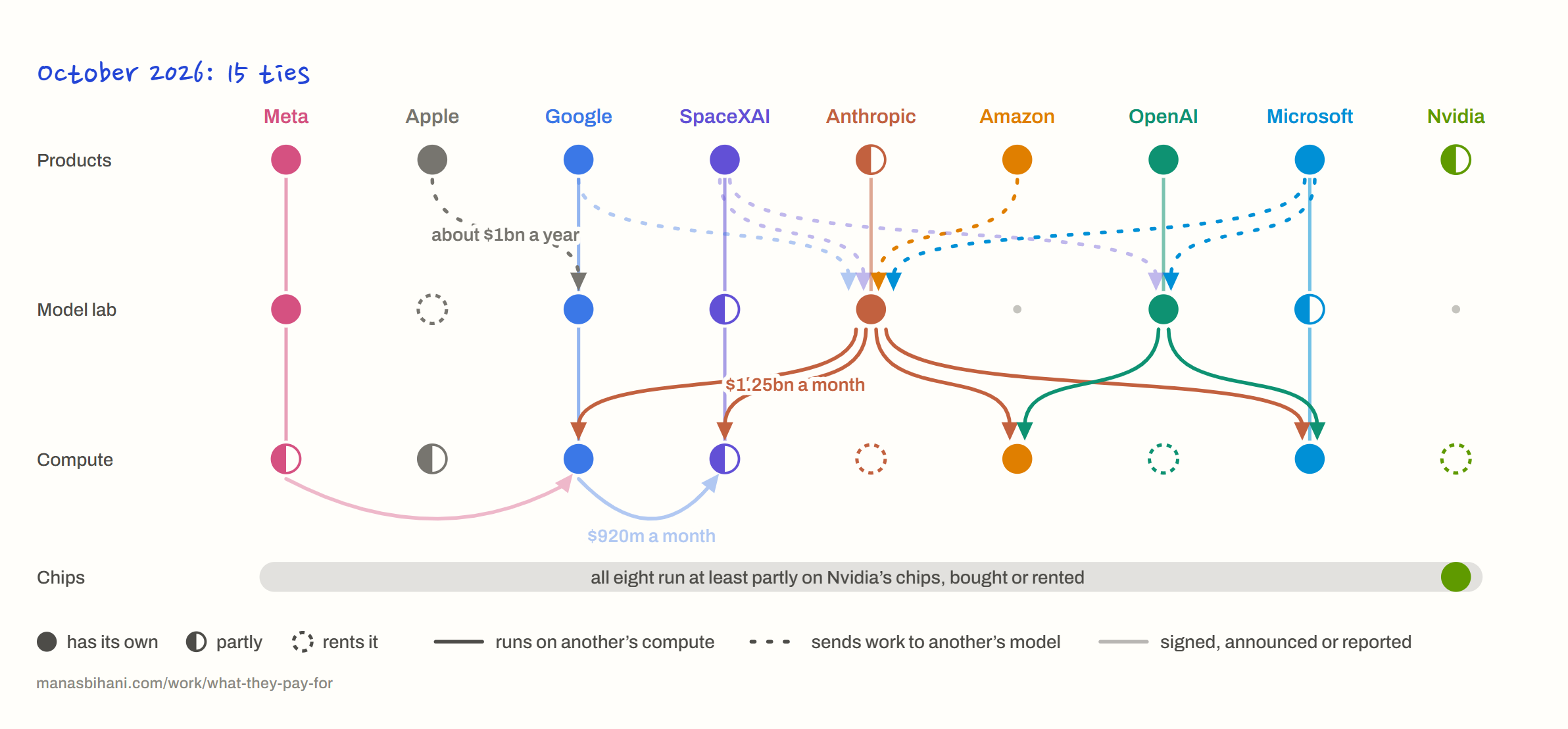
Take the five closest pairs and ask the question nobody in them wants asked:
Google, to Anthropic. Investor: Owns about 14%. Supplier: Sells it chips and cloud. Customer: Its work agent sends work to Claude. Competitor: Builds Gemini.
Microsoft, to OpenAI. Investor: Owns about 27%. Supplier: Its main cloud. Customer: Builds Copilot on its models. Competitor: Ships its own models.
Amazon, to Anthropic. Investor: Has invested $13bn. Supplier: Its main cloud. Customer: Opened its seller tools to Claude. Competitor: Built its own models, now mostly wound down.
Nvidia, to OpenAI. Investor: Owns $30bn and guarantees its lease. Supplier: Sells it chips. Competitor: Gives away open models, while OpenAI builds a chip.
SpaceXAI, to Anthropic. Supplier: Leases it a data centre. Customer: Its Grok Bot sends work to Claude. Competitor: Builds Grok. Every pair holds at least three of the four roles. Calling one the customer and the other the competitor picks one true label out of four.
Everyone is paying for dinner. Amazon, Microsoft, Google and Nvidia have all put money into a lab that then signed for their compute or chips, sometimes on the same day. The Bank for International Settlements found that 55% of the money invested in AI companies from 2021 to 2025 came from other AI companies.5 Amazon and Google fund Anthropic while building models that compete with it. Whichever model wins, they own a piece of it and sell it the electricity.
And everyone keeps their options open. When one tie gives a partner too much power, the company answers through another. Four patterns run through the list.
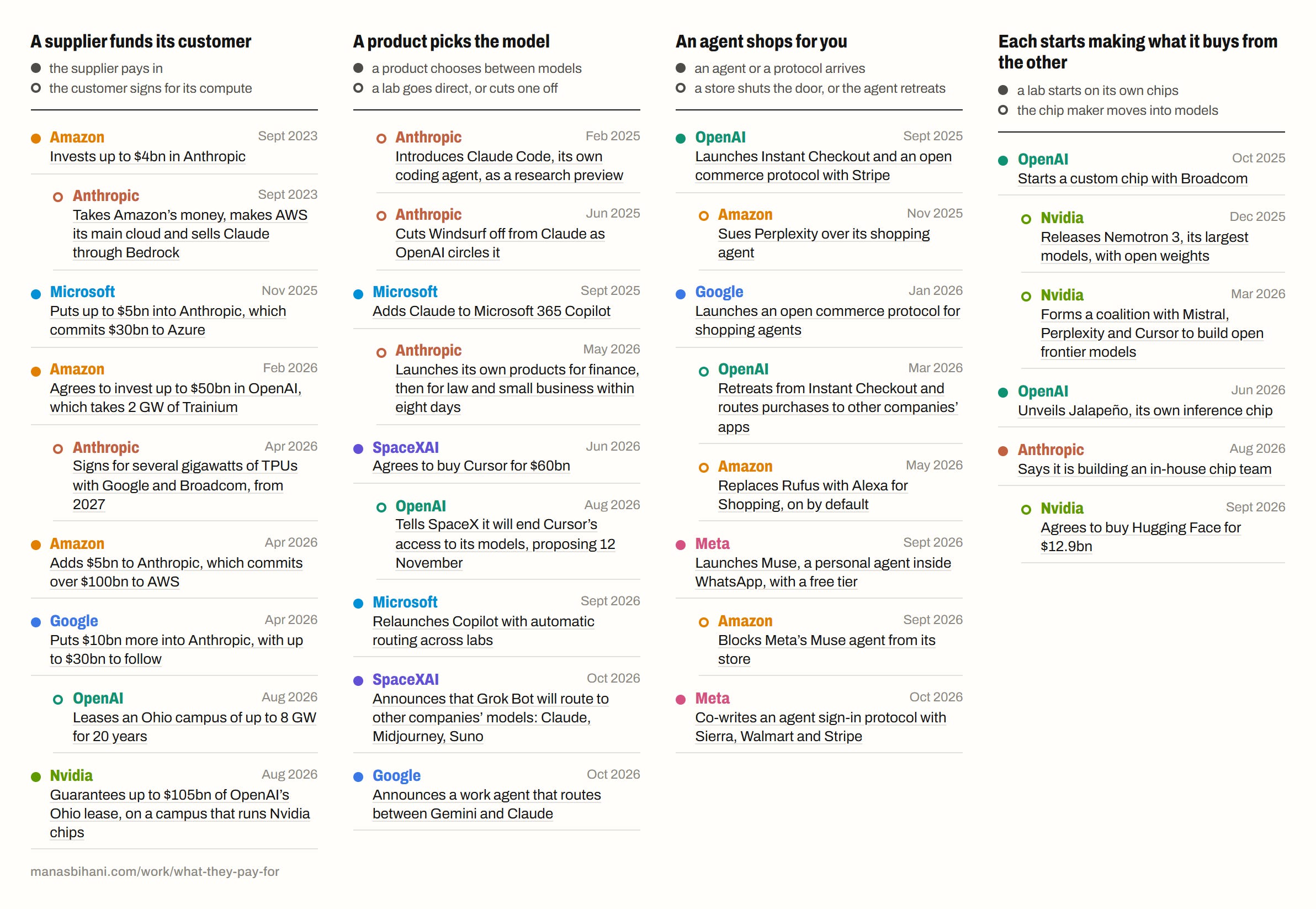
Supplier funds customer, customer signs for supplier’s compute. The tightest knot on the page: Nvidia guarantees up to $105bn of OpenAI’s lease on a campus full of Nvidia chips.
A product starts seeing other models. Microsoft, SpaceX and Google each now have products that pick between labs’ models for the user.6 A lab that’s one option on a menu doesn’t own the customer, so the labs went direct. Anthropic built its own coding agent and cut Windsurf off. When SpaceX bought Cursor, OpenAI told it Cursor would lose access to OpenAI’s models.
An agent shops for you, and the store locks the door. Amazon earns over $68bn a year from adverts, and a shopping agent doesn’t look at adverts. Amazon sued Perplexity over its agent and blocked Meta’s, and says it has blocked Google’s and OpenAI’s too. Meta answered by writing a sign-in standard for agents with Walmart and Stripe.
Each starts making what it buys from the other. Nvidia owns $30bn of OpenAI. OpenAI is building a chip so it can buy fewer of Nvidia’s. Nvidia is giving away models of its own.
Google is the extreme case: the only company with all three seats filled, a cloud, a top lab and products used by billions. So it sits on both sides of every pattern, and the fight between serving a customer and beating a competitor happens inside the building. Its cloud sells chips to Anthropic while its own lab goes short, and the Wall Street Journal reports that Sergey Brin sometimes overrides who gets compute.
What will they build next?
Whatever they’re short of. Seven of the eight companies that run on Nvidia’s chips now have a chip of their own running or in the works. The eighth, SpaceX, went one step further: it’s building the factory.
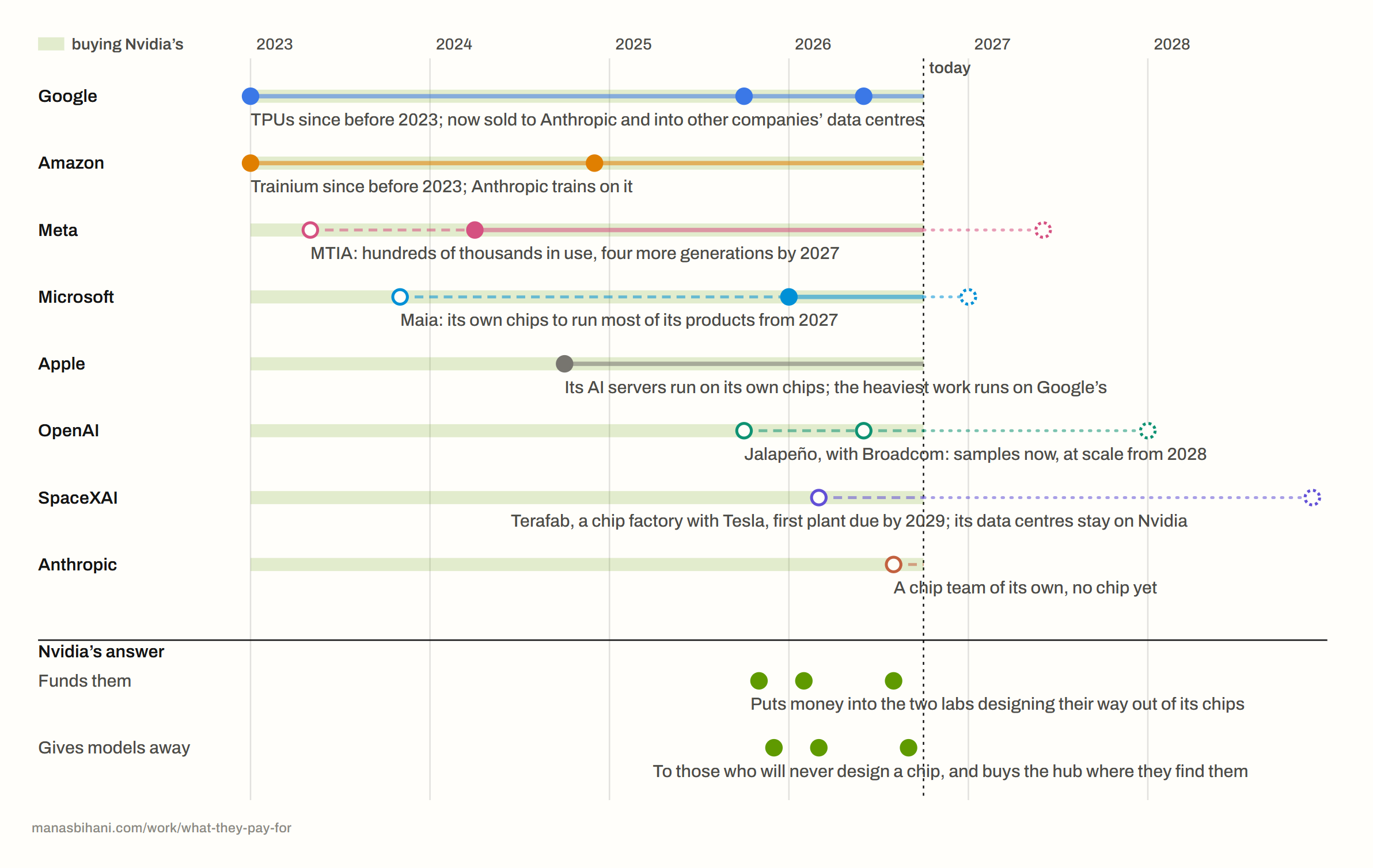
Google and Amazon built chips years ago, because as clouds they hit the bill first. Everyone else started once Nvidia’s chips became the thing you queued for: Meta and Microsoft in 2023, Apple in 2024, OpenAI in 2025, Anthropic this August. This month Microsoft said its own chips will run most of the AI in its products from 2027.7 A week later Amazon and Google both released free software that lets existing AI code run on their chips with one setting changed. That one is aimed at Nvidia’s real moat, which was never just the chip. It was all the code written for it.
The rule is the same at every layer. Whatever you rent that’s scarce, you start to build, and once you have some, you rent it out. Google sells its chips to Anthropic. SpaceX rented its lab’s data centre to a rival. And the scarce thing keeps moving down. In 2023 it was the model, so the clouds bought into labs. Then chips, so they designed their own. Then power: Microsoft paid to restart Three Mile Island, and Google signed for 3.6 gigawatts this month.8 Now it’s the factories. Musk says Terafab, his chip plant with Tesla, aims for volume production in late 2028, and on the same call said the bottleneck is now “more in power and cooling and infrastructure than it is in chips”. The queue just moved again.
So if you want to guess the next move, follow the shortage.
And whoever is being replaced moves to where it can’t be. Nvidia’s biggest customers are the ones rich enough to design their way out. So Nvidia has made itself useful to two groups who won’t. It funds the labs, so it owns part of the two building their own chips. And it gives models away9 to the companies, universities and governments that will never design a chip, and is buying Hugging Face, where those people go to find them. Jensen Huang’s version: “Free AI should be great for hardware.” Joel Spolsky had a name for this twenty years ago, commoditising your complements: make the thing your product is used with cheap, and your product is worth more. Apple is doing the same from the phone. It reportedly designed the new Siri so the model can be swapped out. If any good model will do, the phone is the part you can’t replace.
The labs pull the same trick one layer up. A product that routes between models turns each model into a part, and parts get priced down. So the labs build products of their own and cut off the ones that could swap them. Ben Thompson argues that this is where a lab’s hold lasts: an agent is a model and its software built together, and that’s hard to swap.
Not every tie is being cut. Where a company owns part of what it depends on, depending pays it twice, so it stays. Microsoft is leaving Nvidia, which it only pays, and keeping OpenAI, which it partly owns; it told its engineers to default to OpenAI’s models for “greater value from our token investment”. Amazon leans on Anthropic, which it has put $13bn into. Apple depends on Google for its model, and Google pays Apple to be its search engine, $20bn in 2022. When the money runs both ways, nobody leaves. Even politics follows the supplier: OpenAI has stopped pushing for limits on Nvidia’s chip sales to China.
The whole list leans this way. Leaving out prices and retreats, the nine made something of their own 80 times and took someone else’s 44 times. But building your own hasn’t yet meant needing the others less. Taking grew faster than making: 3 times in 2024, 12 in 2025, 24 so far in 2026. Not one of the fifteen ties on the first chart has ended this year. Everyone is saying they need space. Nobody has moved out.
Who can still charge?
Four kinds of company hold something the others can’t easily replace. A chip maker holds the chip. A cloud holds the running machines. A store or a phone maker holds the customer. And a lab holds its model, for as long as it’s the best one.
That last hold is the shortest, and the market shows it. People don’t pay for the second-best model. Companies’ spending moves to whoever has the best one: OpenAI took half of it in 2023 and Anthropic 40% by the end of 2025, by Menlo Ventures, an investor in Anthropic. And it moves fast. A month after Claude 4 came out, the old Sonnet’s share of Anthropic’s users fell from 83% to 16%. Nobody stays out of loyalty. The other way to win is to be cheap, and Google priced its newest model this month at a fifth of the two labs’ top rate. How the money and the traffic split is in a fold below.
The profit has already changed hands once. From 2023 to 2025 it sat with the chip makers and builders while the labs lost money on every answer. This year it moved toward the labs: by SemiAnalysis’s estimate, Anthropic’s margin on running its models went from minus 94% in 2024 to the sixties this year. Its draft prospectus, seen by the Journal, shows $16.3bn of revenue in the first half and up to $750bn it could spend on compute. Being hard to replace lets you set the price. It doesn’t pay the rent.
Here’s the bet, and it’s mine. The value will settle at whichever layer stays scarce longest, and that is the model only for whoever keeps making the best one. The margins say the opposite for now. So here’s what would prove me wrong: a lab that keeps the biggest share of companies’ spending, at today’s top price, after customers have started switching to a rival’s model. That would mean people pay for the lab, not the lead.
What to watch next
A keynote costs nothing, so watch what they pay for, or stop paying for, next.
Late October to November. Anthropic’s prospectus goes public, then the roadshow, reported for the week of 9 November. OpenAI is reportedly racing to close a roughly $30bn round first. Nothing says “we’re fine” like making sure you’re funded before your ex goes public.
12 November. The date OpenAI proposed for cutting Cursor off its models, now that SpaceX owns Cursor.
30 November. Google’s introductory price for Gemini 4 ends and doubles. If it extends it, Google is buying customers, not charging for a lead.
2027. Microsoft’s own chips start taking over its products. Either side can end SpaceX’s lease to Google on ninety days’ notice. And Terafab hopes to have its first test chip working by mid-year.
Facts on this page are linked to their sources. Where a sentence is my reading rather than a fact, I’ve said so once, here, so the rest can talk plainly. The figures elsewhere are as of 13 October 2026; this month’s news is linked where it appears.
The full version, with every chart interactive, the folded detail and all 186 decisions as data you can download, is at manasbihani.com.